Modern Data Stack “Made in Europe” - A personal update


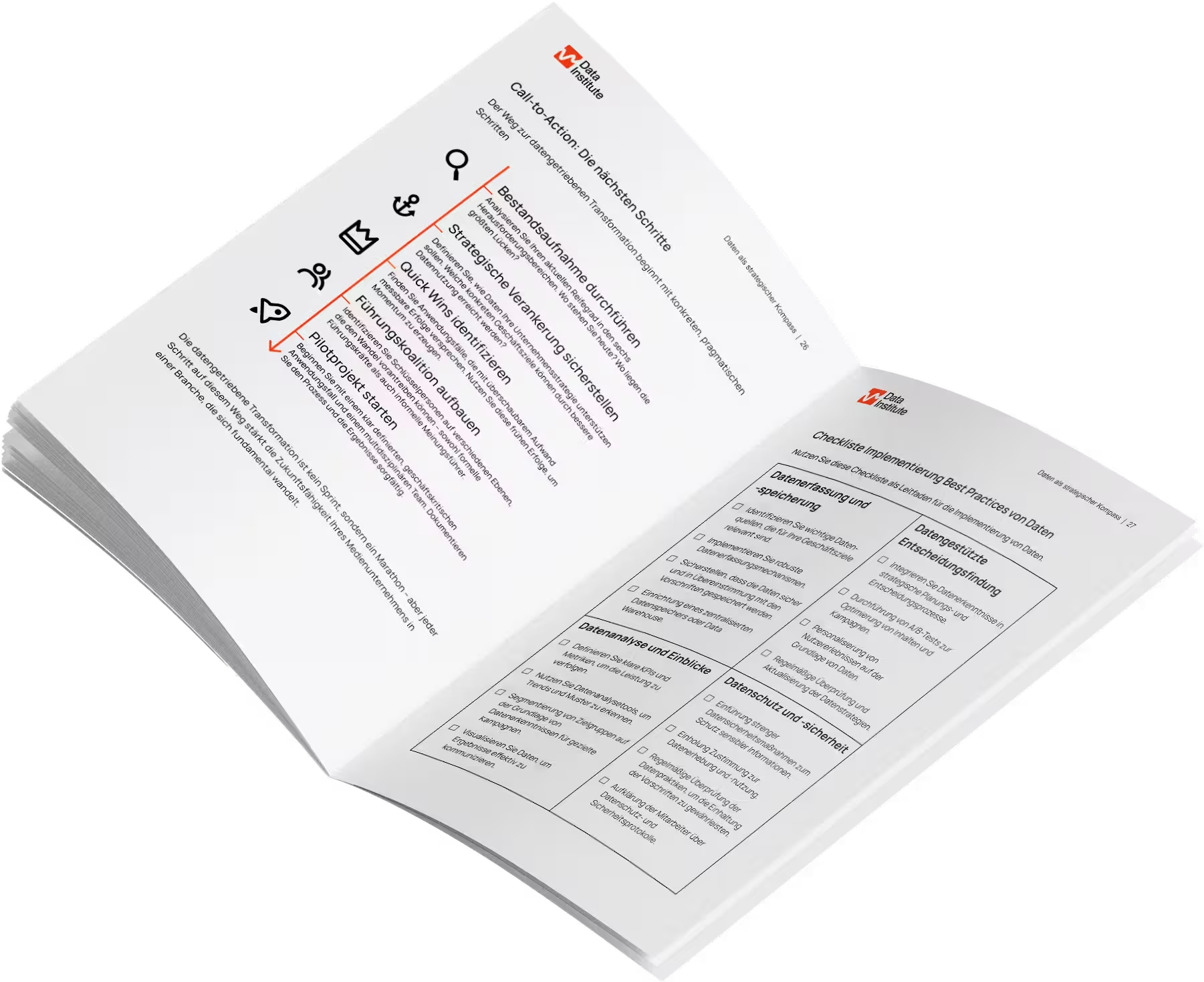
The roadmap for data-driven transformation
The ePaper shows you strategies, success stories and a checklist for a direct start into the digital future.
When I wrote in more detail about a “Modern Data Stack made in Europe” roughly half a year ago, the topic was largely a strategic thought experiment. Dependence on US vendors was obvious, while European alternatives did exist, but often with noticeable functional or ecosystem-related limitations. As a result, my conclusion at the time was deliberately cautious: interesting and relevant, yes—but only partially realistic, and most pragmatically addressed through hybrid approaches.
Since then, the landscape has evolved. Not abruptly, not radically—but enough to justify taking a second, more differentiated look.
The concrete trigger for this update was a technical evaluation published by BARC, which I came across a few weeks ago. I had been invited—almost by chance—to a webinar discussing a sovereign lakehouse architecture based on STACKIT and Dremio. Not because I was actively looking for a European alternative, but because the topic of data sovereignty is currently resurfacing in many conversations with companies. That coincidence prompted me to revisit and reassess my perspective from six months ago.
One clarification upfront: this is not intended as a tribute to a single vendor. STACKIT appears in this article simply because a solid, publicly available study exists for this specific setup. The broader question is more fundamental: how viable are European building blocks today when assessed against modern architectural principles?
What has changed since the last article
In my original piece, I argued that European cloud and data offerings often struggled with two aspects: technical depth and integration into a mature ecosystem. That assessment still holds true in parts. At the same time, it is becoming increasingly clear that some providers are actively addressing exactly these weaknesses.
The architecture analysed by BARC—a lakehouse setup with more than one billion records—is interesting precisely because it is not a theoretical construct. It was tested under realistic conditions. The results indicate that performance, scalability and openness are no longer exclusive to hyperscaler platforms. Open standards, decoupled storage and compute, predictable cost models and a clearly defined regulatory framework are no longer abstract promises—they are technically measurable.
Anyone interested in the details should review the study itself. It offers far more substance than typical marketing material and helps ground the discussion in concrete evidence.
A closer look at the BARC assessment
To properly interpret the results, it is worth examining the tested setup in more detail. The benchmark figures themselves are less important than the architectural decisions behind them.
BARC did not evaluate a proprietary end-to-end platform, but a deliberately modular lakehouse architecture. At its core is the separation of storage and compute, implemented using Apache Iceberg as an open table format, an S3-compatible object store operated by STACKIT, and Dremio as the analytical and semantic access layer. These principles align closely with what is generally understood as a Modern Data Stack.
Data was stored as Iceberg tables in object storage fully operated under European jurisdiction. Dremio sat on top as a query engine and semantic layer, enabling SQL-based analytics for both classical BI workloads and more exploratory use cases. Compute resources were scaled dynamically, without coupling or replication at the storage layer. This decoupling is relevant not only for performance, but also for cost transparency and portability.
The test involved approximately 1.1 billion records across multiple tables and query profiles. The focus was on realistic SQL workloads—aggregations, joins and filters on large datasets—typical of analytical scenarios in many mid-sized organisations. Results showed stable performance, short response times for the majority of queries, and near-linear scalability under increasing load.
From an architectural perspective, what stands out is that this setup operates without proprietary optimisation mechanisms. There are no specialised storage formats, tightly coupled platform services or implicit vendor lock-ins. Performance is achieved through clean, open architecture rather than through enclosure. This contrasts with many established platforms that have expanded significantly in functionality over recent years, but at the cost of increasing architectural closure.
BARC also highlights the cost dimension. By avoiding traditional egress fees and relying on comparatively predictable pricing at the infrastructure and compute level, such a setup becomes easier to plan and budget than many consumption-based platform models. For mid-sized organisations, this is often not a secondary concern, but a decisive one.
It is equally important to note what the assessment does not claim. It does not aim to evaluate a full-fledged data platform including advanced analytics or MLOps capabilities. Instead, it deliberately focuses on a well-defined architectural core: data storage, query execution, scalability and openness. That limitation is precisely what gives the assessment its relevance.
Reality check instead of hype
In my view, the key question is not whether a specific European setup can “compete with AWS or Snowflake.” That comparison is too simplistic. More relevant is which architectural principles can now be implemented reliably with European offerings—and for which types of workloads this matters.
A modern data stack thrives on modularity, open interfaces, clear separation of responsibilities and the ability to replace or extend components selectively. From this perspective, European solutions become interesting when they function as robust building blocks within such an architecture—not when they attempt to replicate full-scale platforms.
This is where the recent developments matter: infrastructure is no longer automatically the limiting factor. The real challenges remain architectural decisions, data models, ownership, operating processes and team capabilities. That was true six months ago and remains true today.
Why a European perspective still makes sense
What has changed, however, is the strategic context. Conversations with companies increasingly revolve around optionality—not in an ideological “Europe first” sense, but as a sober risk assessment. How dependent do we want to be? Where do we need alternatives? And how do we ensure that these alternatives are actually usable if required?
In this context, European technologies should not be seen as replacements, but as complements. They offer a way to design architectures that are more resilient, more diverse and more flexible over the long term.
This movement is not limited to infrastructure. Companies such as Mistral in the AI space or n8n in workflow automation demonstrate that European products can achieve international relevance at different layers of the stack. They do not solve every problem and are not universally the best choice—but they show that substance exists.
What is still lacking are more differentiated, positive field reports and the willingness to experiment deliberately. Without experimentation, ecosystems do not emerge. And without demand, progress stalls.
Conclusion: not a disruption, but meaningful progress
A “Modern Data Stack made in Europe” is still not a default choice, nor a universal recommendation. But it is no longer just a theoretical vision. Certain building blocks are technically sound, strategically relevant and viable in real-world scenarios.
Hyperscalers will remain central players—there is no question about that. At the same time, it is becoming increasingly important for organisations to avoid thinking about architecture exclusively in terms of a single vendor. Openness, modularity and conscious choice are turning into real competitive advantages.
This article is therefore not a final verdict, but a snapshot. And most likely not the last one.
Source note: The technical evaluation referenced in this article was conducted by BARC (“Sovereign Data Management with STACKIT & Dremio”). The study is publicly available here: https://barc.com/research/sovereign-data-management-europe/
European data architecture: Is that also an option for your company?
The strategic question isn't “Hyperscaler or Europe?” , but:
Which architecture fits your requirements for sovereignty, performance, and cost efficiency?
In our architecture assessment we evaluate with you:
- Which workloads are suitable for European infrastructure
- Where hybrid approaches make strategic sense
- How to minimize lock-in risks through open standards
Benefit from our experience from 20+ successful data projects in German SMEs.
European data architecture: Does that fit your requirements?
Together with you, we evaluate which workloads are suitable for European infrastructure, where hybrid approaches make sense and how you can minimize lock-in risks through open standards.
European data architecture: Does that fit your requirements?
Together with you, we evaluate which workloads are suitable for European infrastructure, where hybrid approaches make sense and how you can minimize lock-in risks through open standards.

European data architecture: Does that fit your requirements?
Together with you, we evaluate which workloads are suitable for European infrastructure, where hybrid approaches make sense and how you can minimize lock-in risks through open standards.
Related case studies
There are suitable case studies on this topic