Why 80% of all AI projects fail

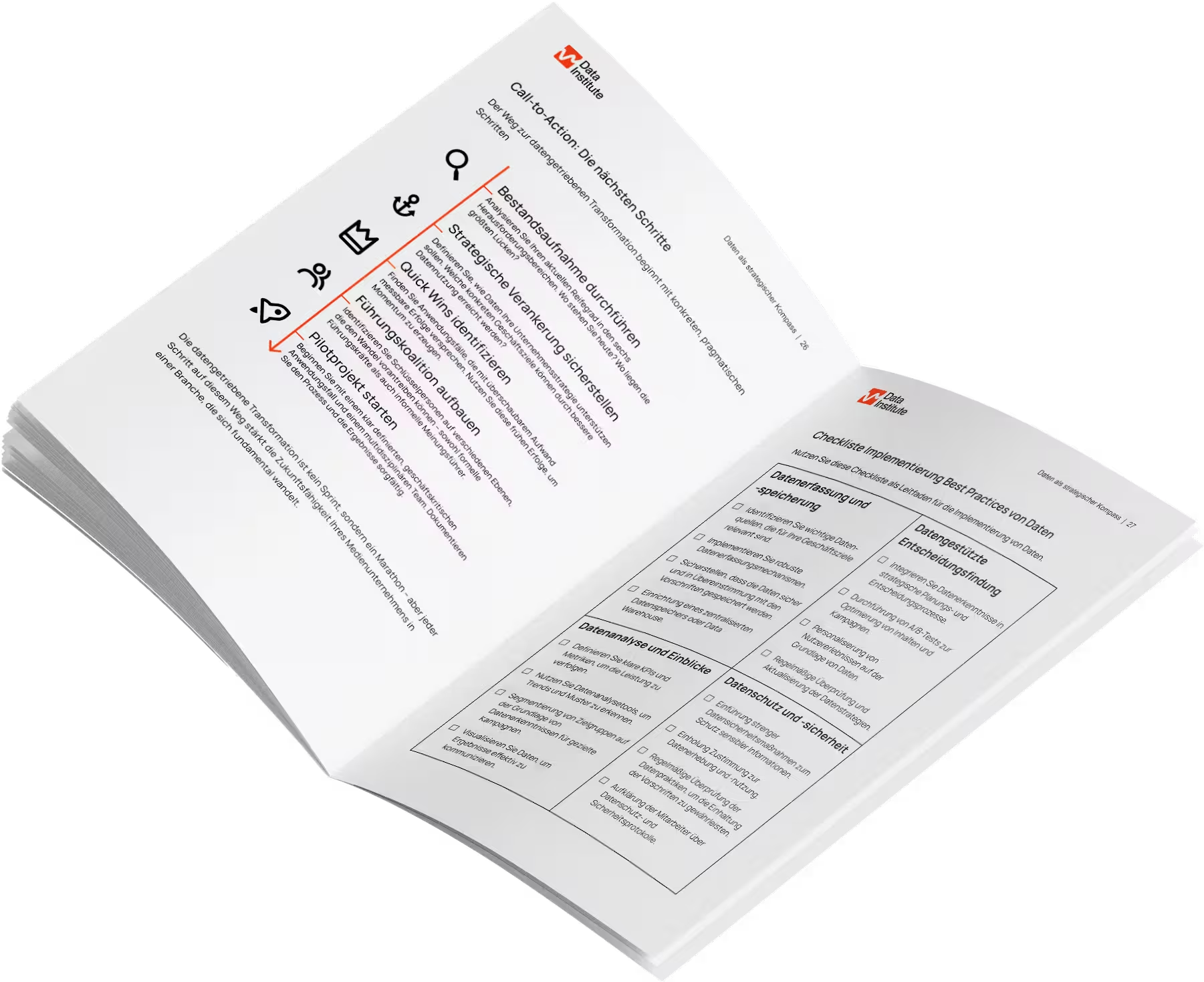
The roadmap for data-driven transformation
The ePaper shows you strategies, success stories and a checklist for a direct start into the digital future.
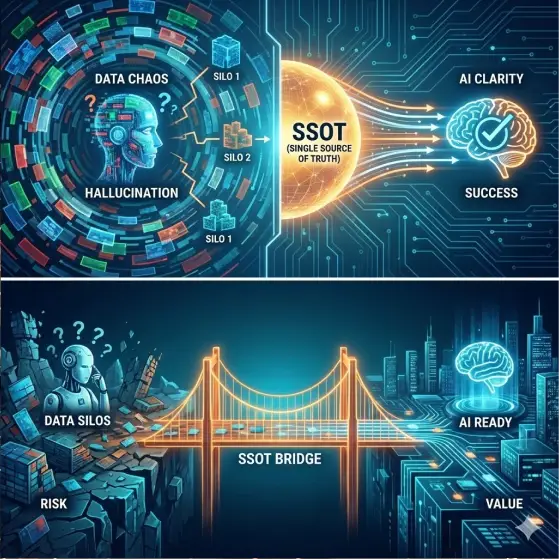
The €2 Million Disaster: When AI Lies
A mid-sized e-commerce retailer invests 18 months and seven figures into an AI-powered customer support bot. The go-live is celebrated. IT magazines publish case studies. Two days later: emergency shutdown.
The reason: The bot promised customers 20% discounts that never existed. It quoted prices from 2021. It communicated incorrect delivery times.
Was the AI broken? No. The AI did exactly what it was designed to do: recognize patterns in data. The problem: product prices were stored in seven different systems (ERP, PIM, online shop, Excel spreadsheets from sales). The AI didn't know which number was correct — so it "hallucinated" a plausible answer.
The damage:
- €1.8 million in project costs wasted
- 47 customer complaints in 48 hours
- Reputational damage on social media
- AI initiative shelved indefinitely
This isn't an isolated case. According to analysts like Gartner, up to 85% of all data and AI projects fail. The most common reason? Poor data quality.
The Uncomfortable Truth: AI Amplifies Your Data Chaos by 10x
There's an old law in computer science: "Garbage In, Garbage Out".
Artificial intelligence doesn't override this law — it amplifies it.
What happens without a Single Source of Truth:
Scenario 1: The CFO asks the AI"How many active customers do we currently have?"
- CRM says: 8,347 customers (including prospects)
- ERP says: 6,892 customers (paid orders only)
- Marketing tool says: 9,124 customers (including newsletter subscribers)
The AI responds: "You have approximately 8,100 active customers." (Average of conflicting sources — sounds plausible, but completely wrong)
Scenario 2: The Sales Director plans a forecastThe AI analyzes historical sales data. Problem: Q3 figures exist in three versions (different calculation logic). The AI trains on inconsistent data.
The result: Forecast is 23% off. Overproduction. Warehouse costs explode.
"The biggest misconception about AI is that it brings order to chaos. In reality, AI is an amplifier: It makes good data brilliant — and messy data catastrophic." - Thomas Borlik, The Data Institute
Why RAG (Retrieval Augmented Generation) Requires an SSOT
Modern enterprise AI typically uses RAG technology (Retrieval Augmented Generation). Here's the difference from ChatGPT:
ChatGPT: Trained on public internet data through 2023. Doesn't know your company data.
RAG System: Searches your company data in real-time before answering.
How RAG works (simplified):
User asks: "What was our Q3 revenue?"
Retrieval Step: System searches your databases for relevant documents
Augmentation Step: AI receives found data as context
Generation Step: AI formulates answer based on this data
The critical point: Step 2
If your "Retrieval Step" is fishing in a data swamp instead of a Single Source of Truth, you get:
❌ Contradictory answers depending on timing
❌ Outdated information (because it's unclear which version is current)
❌ Hallucinations (AI invents numbers to fill gaps)
The Library Analogy:
Think of RAG as a librarian:
With SSOT: The librarian goes to the "Truth" shelf, pulls the one verified document, and reads it aloud. Same correct answer every time.
Without SSOT: The librarian finds 7 folders with conflicting notes, panics, and invents a story that somehow connects all 7. Sounds plausible — but it's fiction.
The 4 AI Use Cases That Fail Without SSOT
1. Customer 360 Chatbots
The Promise: Your bot knows every customer — order history, support tickets, preferences.
The Reality without SSOT:
- CRM has a different customer ID than the shop system
- Support tool shows a different email address
- Bot doesn't know "Max Smith" and "M. Smith" are the same customer
The Result: Bot sends offers for products the customer already purchased. Trust destroyed.
2. Predictive Analytics (Forecasting)
The Promise: AI predicts which products will be in demand next month.
The Reality without SSOT:
- Historical sales figures exist in Excel sheets (version 1, 2, 3...)
- Returns are counted in some reports but not others
- Seasonality calculated differently across systems
The Result: AI forecast is guesswork with a glossy UI. €340K in overproduction costs.
3. GenBI (Natural Language to SQL)
The Promise: Managers type "Show me top 10 products by margin" — AI generates SQL query.
The Reality without SSOT:
- "Margin" is defined differently in 3 systems
- AI doesn't know which table contains the truth
- Query returns wrong numbers → bad decisions
The Result: Tool sits unused. €80K in license costs wasted.
4. Automated Management Reports
The Promise: AI writes Monday reports automatically. No more manual work.
The Reality without SSOT:
- Report cites conflicting figures from different sources
- Management loses trust
- Back to manual Excel reports
The Result: AI project labeled as "not ready for prime time."
Practice Check: What MediaPrint Did Differently
Our client MediaPrint (media company, 500+ employees) faced exactly this challenge:
Starting Situation:
- Product data in 7 different systems
- Prices and inventory never synchronized
- Silos in thinking and workflows
The Decision:Before launching AI initiatives, MediaPrint invested in a Single Source of Truth.
The Implementation:
Data Audit: We identified all data sources and inconsistencies
Data Engineering: ELT pipelines feed data into a central data warehouse (Snowflake)
Data Modeling: Business logic defined once ("What is the current price?")
Data Governance: Clear data owners for every data point
The Results after 6 months:
✅ 47% fewer customer complaints due to price inconsistencies
✅ 60% faster time-to-market for new products
✅ Meeting culture transformed: Discussions about strategy instead of Excel versions
✅ AI-ready: Chatbot deployed successfully — doesn't hallucinate because it accesses SSOT
"We originally wanted to start directly with an AI chatbot. The Data Institute convinced us to build the foundation first. In hindsight, that was the best decision. Without SSOT, our bot would have caused more damage than good."— Alexander Ebner, CDO MediaPrint
Read the full MediaPrint case study →
The SSOT-to-AI Roadmap: 4 Phases to Success
Phase 1: The Reality Check (Weeks 2-4)
Tool: Data Audit
Questions answered:
- Where does our data currently reside? (system landscape)
- How consistent is it? (duplicates, contradictions)
- Which data is "toxic" for AI? (inconsistencies that trigger hallucinations)
Output: Prioritized roadmap showing which data sources need cleaning first
Phase 2: The Foundation (Weeks 4-12)
Tool: Data Engineering
What happens:
- ELT pipelines: Automated data flow from silos to central repository
- Data warehouse setup (Snowflake, BigQuery, Databricks)
- Data modeling: "How do we define 'revenue'?" — defined once, used everywhere
Output: Functioning Single Source of Truth. All systems sync with this source.
Phase 3: The Rules (Weeks 8-16, parallel to Phase 2)
Tool: Data Governance
Critical questions:
- Who owns "customer address" data? (If AI gives wrong address, who's responsible?)
- Who can change master data?
- How do we ensure new data sources don't reintroduce chaos?
Output: Data governance framework with clear roles, processes, and responsibilities.
Phase 4: AI Activation (Week 16+)
Tool: ML & AI Readiness
Now — and only now — connect AI:
- RAG system accesses your SSOT
- Chatbots use validated, consistent data
- Predictive models train on clean historical data
- GenBI generates SQL queries on defined data logic
Output: Production AI applications that build trust instead of destroying it.
Frequently Asked Questions (FAQ)
Do I need to shut down my old ERP system to have SSOT?
No. Your ERP often remains the "source of record" for financial data. Accounting continues working directly in ERP.
For analysis and AI, this data is copied to the SSOT (data warehouse) and combined with data from CRM, shop, marketing tools, etc. AI accesses the warehouse, not the ERP directly.
Example: Your ERP has invoice data. Your CRM has customer communication. The SSOT connects both: "Customer X generated €50K revenue AND has 3 open support tickets." This 360° view is the foundation for intelligent AI.
Can't I just start AI projects with "clean data" — without SSOT?
Theoretically yes. Practically, you'll fail medium-term.
The problem: Without SSOT architecture, there's no guarantee data stays clean. After 6 months, you'll have new silos, new Excel sheets, new inconsistencies.
SSOT isn't a one-time cleanup — it's an architectural principle. It ensures new data sources automatically integrate into the central system without creating new silos.
How long does building an SSOT take, and what does it cost?
Duration: 8-16 weeks for a functioning Minimum Viable Product (MVP).
Cost: Depends on your system landscape. A mid-market company (3-5 critical data sources) typically invests €80K-150K.
ROI: MediaPrint recouped the investment in 11 months through:
- Reduced customer complaints (€120K saved)
- Avoided overproduction (€340K saved)
- Faster time-to-market for new products
Cost of inaction: Failed AI projects cost €500K-€2M on average (Gartner, 2024). SSOT is insurance against this risk.
Conclusion: Data Quality is the Real AI Competitive Advantage
AI models are now commodities. Anyone can rent GPT-4. Anyone can license Claude or Gemini.
Your only true competitive advantage is your own clean data.
Companies with a Single Source of Truth:
✅ Use AI productively (no hallucinations)
✅ Make faster, better decisions
✅ Scale AI initiatives without losing trust
Companies without SSOT:
❌ Burn budget on pilots that never reach production
❌ Lose trust in data and AI
❌ Remain stuck in manual Excel processes
Is Your Data AI-Ready? Take the Check.
Free 60-Minute AI Readiness Check:
✅ We analyze your system landscape
✅ Identify critical data risks for AI
✅ Recommend prioritized next steps
👉 Schedule Your AI Readiness Assessment
Or want to first understand where your data foundation stands?
Is your data AI-ready? Find out in 60 minutes.
Duration: 60 minutes | Format: Video call | Cost: €0
Is your data AI-ready? Find out in 60 minutes.
Duration: 60 minutes | Format: Video call | Cost: €0

Is your data AI-ready? Find out in 60 minutes.
Duration: 60 minutes | Format: Video call | Cost: €0
Related case studies
There are suitable case studies on this topic





Which services fit this topic?