After SSOT: Data Readiness for autonomous AI agents


The roadmap for data-driven transformation
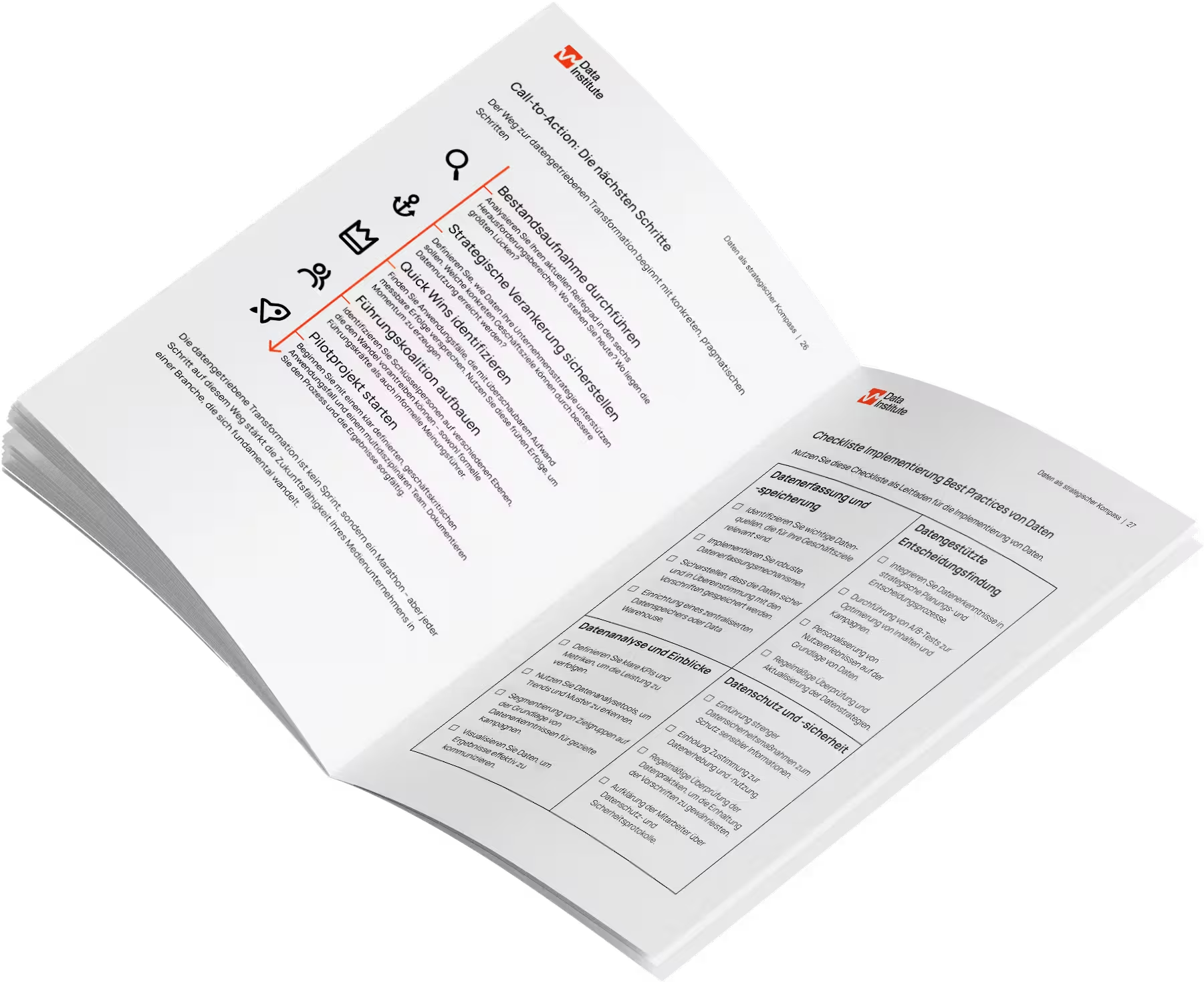
The ePaper shows you strategies, success stories and a checklist for a direct start into the digital future.
SSOT Alone Isn't Enough: Why 95% Fail at Scaling
Many companies believe that once they've established a Single Source of Truth, the work is done. The reality is more sobering: A clean data warehouse doesn't yet produce intelligent decisions.
Organizations often assume that with an established SSOT, they're ready for AI. But the latest MIT study "GenAI Divide: State of AI in Business 2025" reveals a harsher truth: 95% of all AI pilot projects fail at scaling – not due to lack of data access, but due to lack of actionability.
The difference? SSOT creates order and prevents your AI from hallucinating (as we explained in our article on why AI projects fail without SSOT). Data Readiness makes your data actionable – it enables AI agents not just to read, but to decide and act autonomously.
SSOT is the foundation. Data Readiness is the engine.
The KPI Alignment Problem: What Freie Presse Had to Do Differently
Data access is worthless if your systems can't agree on a common language.
At our client Freie Presse Media group, this problem became exemplary: The data was technically centralized (SSOT in progress), but the business logic was fragmented. Marketing defined "active subscriber" differently than sales. Reach measurement used different metrics than the advertising department.
Had we deployed an AI agent directly here, it would have made fatal decisions based on contradictory KPI definitions – not because the technology failed, but because the semantic layer was missing.
The solution wasn't more data integration, but KPI alignment:
- Unambiguous definition of all business metrics in the data layer
- Harmonization of calculation logic across all departments
- Documentation of the "single point of truth" for each metric
The result: Only after the business logic was cleanly modeled in the semantic layer could we deploy production-ready AI applications.
Before you let an agent "run," you must teach it how your company defines "walking."
RAG + Semantic Layer: From Data Access to Contextual Understanding
An AI agent without a semantic layer is like a new employee who has access to the archive but doesn't understand the technical terminology.
In our article about SSOT, we introduced RAG (Retrieval-Augmented Generation) as the technology that "grounds" AI with your enterprise data. Today, we go one step deeper: RAG is only as good as the semantic quality of your data architecture.
The problem without a Semantic Layer:Your RAG system searches the SSOT and finds:
- "Customer" in CRM (all contacts, including leads)
- "Customer" in ERP (only paying accounts)
- "Customer" in support tool (all with ticket history)
The AI receives three contradictory definitions and hallucinates an answer that sounds plausible but is technically incorrect.
The Solution: Semantic LayerThe Semantic Layer is the translation layer between your raw data and business logic:
- It defines once what "active customer" means
- It semantically links the various system IDs correctly
- It ensures the AI understands the meaning behind the numbers
Studies show: RAG with a clean Semantic Layer reduces hallucinations by 54-68% (npj Digital Medicine, 2025) – without this layer, RAG remains a roulette game.
RAG without semantics is like GPS without map data: technically functional, practically useless.
The Leap to Agentic AI: From "Read" to "Act"
The fundamental difference between yesterday's dashboard and tomorrow's agent is the step from passive reading to autonomous action.
Classic BI and even simple GenBI (Generative Business Intelligence) answer questions: "What was revenue in Q3?" or "Show me the top 10 products by margin."
Agentic AI, however, executes tasks autonomously:
- "Analyze the revenue decline and suggest three prioritized measures to sales"
- "Identify customers with churn risk and trigger personalized retention campaigns"
- "Automatically optimize advertising budget based on performance data from the last 7 days"
The critical difference for your architecture:
While humans consume dashboards with their eyes, autonomous agents require structured, machine-readable service APIs:
- Not: beautiful visualization → but: documented REST/GraphQL endpoints
- Not: manual interpretation → but: automatable business logic
- Not: dashboard clicks → but: event-driven workflows
This is the core of Data Readiness for Agentic AI: Your data products must no longer only be readable for human analysts, but available as stable services for digital employees.
We're no longer building dashboards for managers – we're building APIs for your autonomous agents.
Your Roadmap: From SSOT to Autonomous Agents
Those who take the second step before the first will stumble. That's why establishing SSOT is foundational.
The evolution to an agent-capable data architecture follows a clear path – shortcuts lead to the 95% of failed projects.
Step 1: Establish SSOT (✓ Foundation Laid)
→ See our article: Why AI projects fail without SSOT
Status Check: Do you have a central, validated data source for your critical business data?
Step 2: KPI Alignment & Semantic Harmonization (Week 4-12)
- What: Unambiguous definition of all business metrics
- How: Cross-functional workshops with business units + data engineers
- Output: Documented business rules in the semantic layer
- Example Freie Presse: Harmonization of 47 different metrics to 12 core KPIs
Step 3: RAG Infrastructure & Vector Database (Week 8-16)
- What: Implementation of retrieval architecture
- Technology: Vector embeddings, similarity search, context injection
- Output: GenBI-capable infrastructure with documented data provenance
- Governance: Automatic tracking of data sources for audit trails
Step 4: Service Readiness for Agents (from Month 4)
- What: Transformation of analyses into autonomy-capable services
- Architecture: API-first design with clear SLAs
- Security: Sandboxing, rate limiting, human-in-the-loop for critical actions
- Output: Production-ready data products that agents can consume
Those who set the right course today will have the decisive advantage tomorrow – while competitors are still stuck in POC hell.
The Analogy in Closing: From Compass to Autopilot
In our SSOT article, we explained why SSOT is like a precise map – without it, your AI pilot flies blind. Today, we extend the analogy:
The Evolution of Data Architecture:
- Classic BI = Compass
Shows direction, pilot must manually navigate and make all decisions - GenBI with RAG = GPS
Delivers contextual real-time answers, but pilot must still steer themselves - Agentic AI = Autopilot
Takes autonomous control based on defined rules and objectives
The critical point: You cannot install an autopilot in an aircraft that has neither GPS nor updated flight routes. That's exactly what 95% of failed AI projects attempt – they skip the infrastructure work and wonder why the agent crashes.
The Data Institute delivers the complete navigation system – from the map (SSOT) to GPS (RAG + Semantic Layer) to flight rules (Data Governance) – so your autopilot arrives safely at its destination.
Is your architecture agent-ready? Find out – free of charge.
Schedule a 60-minute Data Readiness Assessment now. We analyze your current data architecture and show specifically which steps are needed to move from SSOT to Agentic AI.
Is your architecture agent-ready? Find out – free of charge.
Schedule a 60-minute Data Readiness Assessment now. We analyze your current data architecture and show specifically which steps are needed to move from SSOT to Agentic AI.

Is your architecture agent-ready? Find out – free of charge.
Schedule a 60-minute Data Readiness Assessment now. We analyze your current data architecture and show specifically which steps are needed to move from SSOT to Agentic AI.
Related case studies
There are suitable case studies on this topic


Which services fit this topic?