DG Implementation: The Roadmap ROI Lever


The roadmap for data-driven transformation
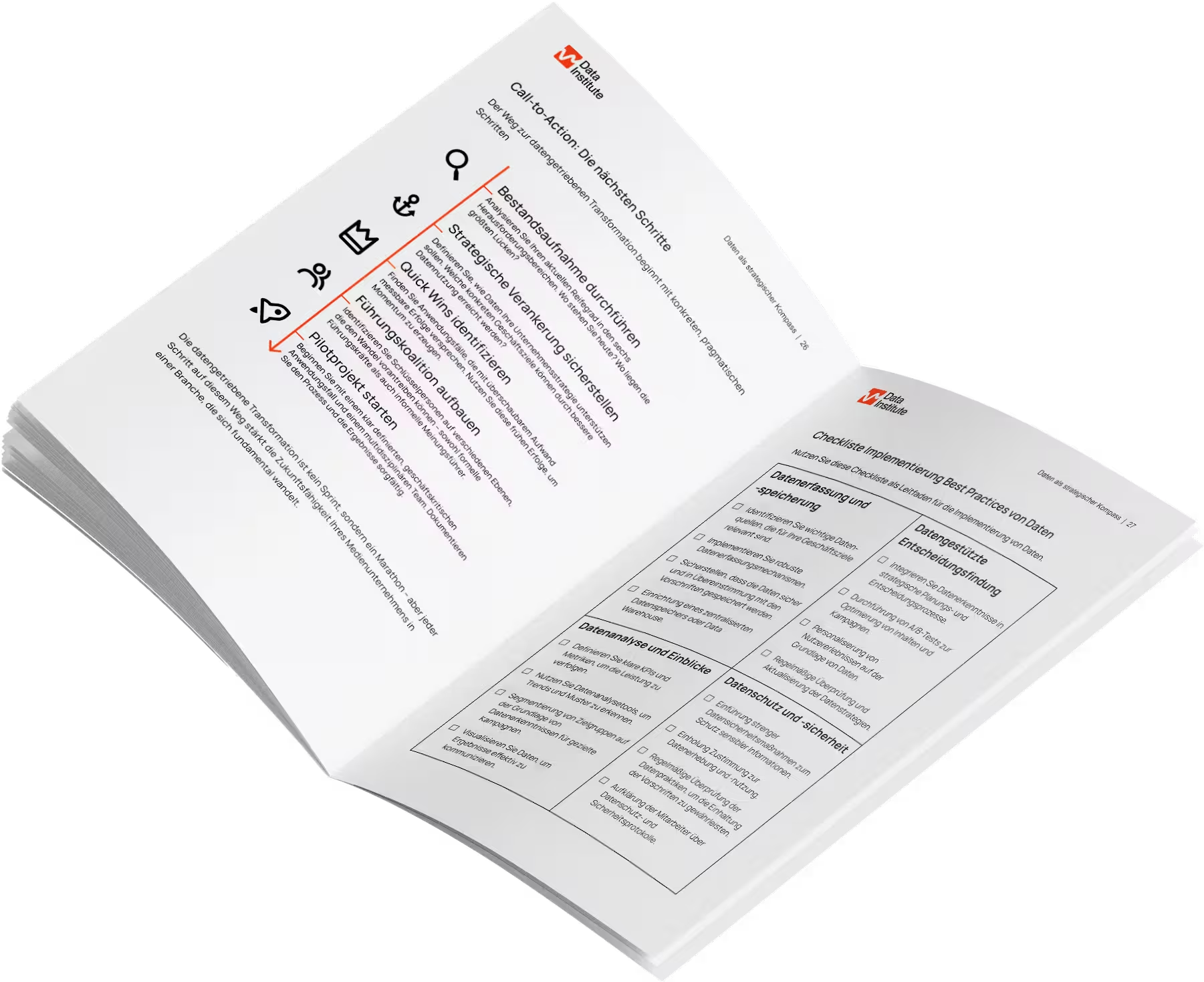
The ePaper shows you strategies, success stories and a checklist for a direct start into the digital future.
Developing a DG implementation roadmap PMO is not a technical task – it's a leadership challenge. In my career as Managing Partner at The Data Institute, I've observed a pattern: data strategies rarely fail because of architecture. They fail due to lack of coordination, silos that nobody breaks down, and missing business alignment.
The typical scenario: IT implements a modern Data Catalog tool, invests months in technical integration – and after go-live, nobody uses it. Why? Because Data Governance was treated as an IT project, not as a strategic program. This is where the Project Management Office (PMO) comes into play, often the most underestimated force in transformation.
The Underestimated Role of the PMO in DG Implementation
In German mid-market companies, I regularly experience a fundamental language barrier. The IT department speaks about "metadata repositories" and "data lineage." Sales wants "faster reports" and "reliable numbers." Marketing needs "consistent customer views." In between: radio silence.
A Data Architect cannot bridge this gap – their expertise lies in technical excellence, not in political navigation. This is precisely where the strength of a professional PMO lies:
The PMO acts as a translator between worlds:
- It translates business pain into technical requirements
- It makes Data Governance measures measurable in Euros
- It coordinates competing priorities across departmental boundaries
- It ensures that the roadmap doesn't shatter on silo thinking
At MediaPrint, it wasn't the technology that led to 87% time savings – it was the coordination effort that brought all stakeholders to the table and kept them there.
The TDI Framework: Organization Before Architecture
Many companies make the same mistake: they buy the tool first. Collibra, Alation, Informatica – all excellent solutions. But a bad process only becomes a faster bad process through software.
Our TDI Framework reverses the order and gives the PMO a clear orchestration plan:
1. Organization: Who can do what?
- Establishment of clear roles: Data Owner, Data Steward, Data User
- Definition of responsibilities along the data lifecycle
- Creation of governance structures (Steering Committee, Working Groups)
2. Culture: Why are we doing this?
- Communication of business value, not technical features
- Building Data Literacy at all levels
- Establishment of a "Data Champions" program for early adopters
3. Architecture: How do we implement it?
- Only now: Selection of appropriate tools based on maturity level
- Implementation in iterations, not Big Bang
- Technical integration follows organizational clarity
My conviction from dozens of projects: Architecture must follow organization, never vice versa. The PMO ensures this sequence is maintained – against constant pressure to "finally get started" and buy a tool.
The 3-Phase Roadmap: Iteration Instead of Waterfall
Forget two-year master plans. Our Iteration-First method reduces planning time from months to weeks and delivers measurable value in quarters instead of years.
Phase 1: Status Quo & Business Case (Weeks 1-4)
Goal: Understand where we stand – and why change is worthwhile.
Data Readiness Assessment
The PMO doesn't conduct an abstract "maturity assessment," but asks hard questions:
- How many hours does Sales lose per week due to contradictory numbers?
- Which strategic decisions were delayed because data wasn't available?
- Where do "Excel truths" exist that are maintained parallel to system data?
The reality: 30% of all data projects fail due to poor data quality before the first analysis even runs. An honest assessment prevents you from building on sand.
The Value Driver Tree: From Pain to Euros
This is where strategy separates from wishful thinking. The PMO uses the Value Driver Tree to mathematically link DG measures with corporate goals:
Sales Example:
- Corporate goal: +15% margin
- Lever: Reduction of discounts through better customer segmentation
- Prerequisite: Consolidated, quality-assured customer data
- DG measure: Master Data Management for customer master data
- Measurable ROI: Reduced error rate in discount granting
Pragmatic Start
Insight from Ole Bossdorf, (Chief Analytics Officer at Project A) and Jonas Rashedi (Chief Digital Officer at Falke).
"Draw the driver tree first – without numbers. Use a whiteboard or Miro. Visualize the dependencies."
The biggest insights lie not in the boxes themselves, but in the overlaps – exactly where teams should be talking to each other but aren't. Have teams compile the first data manually. This deliberately "painful" process immediately shows where data quality is truly deficient – before you buy expensive tools.
Insights from YouTube video https://www.youtube.com/watch?v=a_m0OX2su4g
PMO Deliverable Phase 1:
- Stakeholder map with concrete pain points
- Value Driver Tree (visual, with and without numbers)
- Prioritized backlog of DG initiatives by ROI potential
Phase 2: The Quick Win as Proof of Concept (Weeks 5-12)
Goal: Build trust through measurable success.
The deadliest thing for Data Governance is academic talk without visible results. We need a Quick Win that delivers within 8-12 weeks.
Focus on ONE Critical Use Case
The PMO selects strategically:
- High visibility (many stakeholders affected)
- Clear pain point (measurable time waste or error rate)
- Technically feasible without Big-Bang integration
Practical Example: The weekly sales report that previously required three days of manual consolidation from five Excel sheets:
- Before: 3 days work, inconsistent numbers, constant follow-up questions
- After: Automated report, validated data quality, available at the push of a button
- Effect: The Sales Director becomes an ambassador for Data Governance
At a regional publisher, this approach led to 65% reduction in report creation time and 28% higher conversion rate – in 10 weeks instead of 6 months.
Establish Quality as Currency
The Quick Win proves not only speed, but above all: reliability. Tuned instruments sound better than loud ones. This phase creates the trust in data quality that is essential for any scaling.
PMO Deliverable Phase 2:
- Functioning proof of concept in production
- Measurable success metrics (time, error rate, user satisfaction)
- Documented business case with actual numbers
Phase 3: Scaling & Tool Strategy (from Month 4)
Goal: Systematization and structural anchoring.
Only now, when process and culture are basically functioning, do we invest in structural scaling.
Data Champions as Multipliers
The Data Champions Program has proven extraordinarily effective at MediaPrint (94% acceptance rate):
Profile of a Champion:
- Department expertise + interest in data
- Strong communicator and respected in the team
- Time budget: 20-30% for DG activities
Role:
- Translator between department and data team
- First point of contact for data quality questions
- Identification of new use cases
As Ole from Project A puts it: We're looking for analysts who act like "race engineers," not mechanics. They must provide recommendations for action, not just build dashboards.
Structured Tool Evaluation
Only now does the PMO take over tool-agnostic selection. The critical questions:
Maturity Check:
- Do we have the organizational prerequisites for an enterprise tool?
- Is our data architecture consolidated enough for central governance?
- Do we have the skills to operate complex tools?
Tool Categories by Maturity:
My advice from a PMO perspective: Start lean. At babymarkt, we achieved a 60% reduction in data inconsistencies with dbt and open-source tools – without enterprise licensing costs. Upgrade when the pain is big enough, not when the sales pitch is good.
Institutionalize Governance Structures
The PMO now establishes permanent structures:
- Data Governance Council: Quarterly strategy alignment at executive level
- Data Quality Working Group: Monthly operational coordination
- Role-based trainings: Specialized training for Data Stewards vs. Data Users
PMO Deliverable Phase 3:
- Active Data Champions network
- Selected and implemented tool landscape
- Documented and lived governance processes
- Scaling plan for additional use cases
The Conductor Metaphor: Three Elements in Harmony
A DG implementation roadmap without a strong PMO is like an orchestra without a conductor. But even the best conductor needs:
- A score – the Value Driver Tree shows which piece we're playing and why
- Tuned instruments – assured data quality as a basic prerequisite
- Musicians who play together – the cultural transformation through Champions
When these three elements are synchronized by the PMO, the result is not noise but a symphony. And ultimately: measurable value creation.
Conclusion: The Implementer Beats the Architect
In theory, Data Governance sounds logical. In practice, it's a complex change program that fails due to politics, silos, and lack of coordination – not technology.
The PMO is the implementer who:
- Brings business and IT to the table and keeps them there
- Makes ROI measurable before budget flows
- Delivers Quick Wins that convince skeptics
- Selects tools only when the organization is ready
At MediaPrint (87% time savings), babymarkt.de (60% fewer inconsistencies), and at the regional publisher (65% faster reports), it wasn't the technology that made the difference. It was the coordination performance of a strong PMO that orchestrated the triad of culture, organization, and architecture.
Position Data Governance as what it is: A business enabler, managed through professional management, not through IT projects.
Transform data governance from a chore into a measurable value driver.
You now know that data governance is not a one-off IT ticket, but a complex program. Successfully managing the 3-phase roadmap (status quo, quick win, scaling) is a management task.
Do you want to ensure that your DG program does not fail due to poor data quality or cultural resistance? We help you deliver measurable results, from the strategic vision to the first quick win.
Contact us for a no-obligation initial consultation. We will discuss how you can use the driver tree to quantify the ROI of your data initiatives.
And if you want to get started right away, simply book a no-obligation appointment with us.
Is your data strategy ready for reality?
Paper is patient — practice isn't. In 30 minutes, let's check whether your roadmap is holding up or if you're running into a dead end. Honest feedback, not a sales pitch.
Is your data strategy ready for reality?
Paper is patient — practice isn't. In 30 minutes, let's check whether your roadmap is holding up or if you're running into a dead end. Honest feedback, not a sales pitch.

Is your data strategy ready for reality?
Paper is patient — practice isn't. In 30 minutes, let's check whether your roadmap is holding up or if you're running into a dead end. Honest feedback, not a sales pitch.
Related case studies
There are suitable case studies on this topic




Which services fit this topic?